Q1 2026 Recall Roundup: Ford Dominates as Rearview Camera Issues Persist
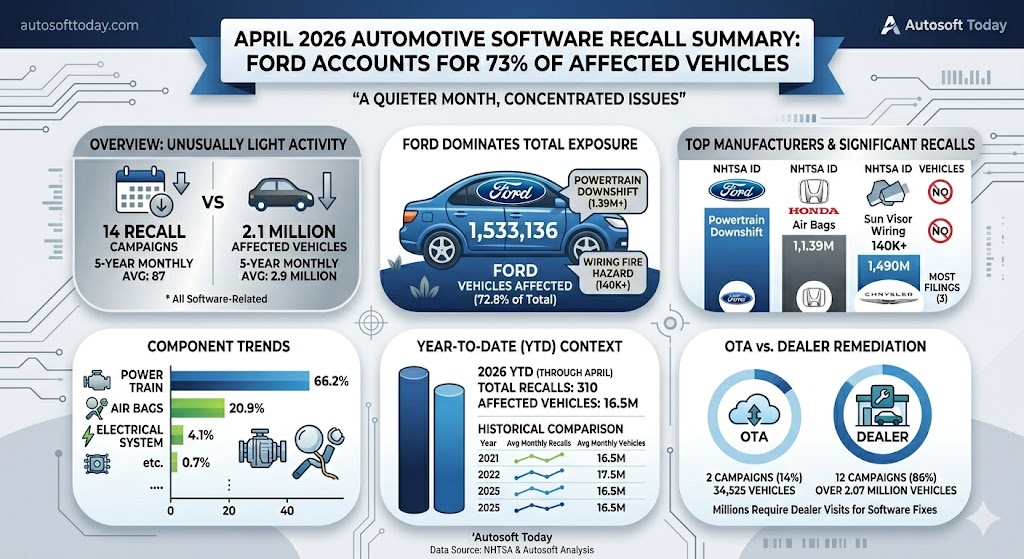
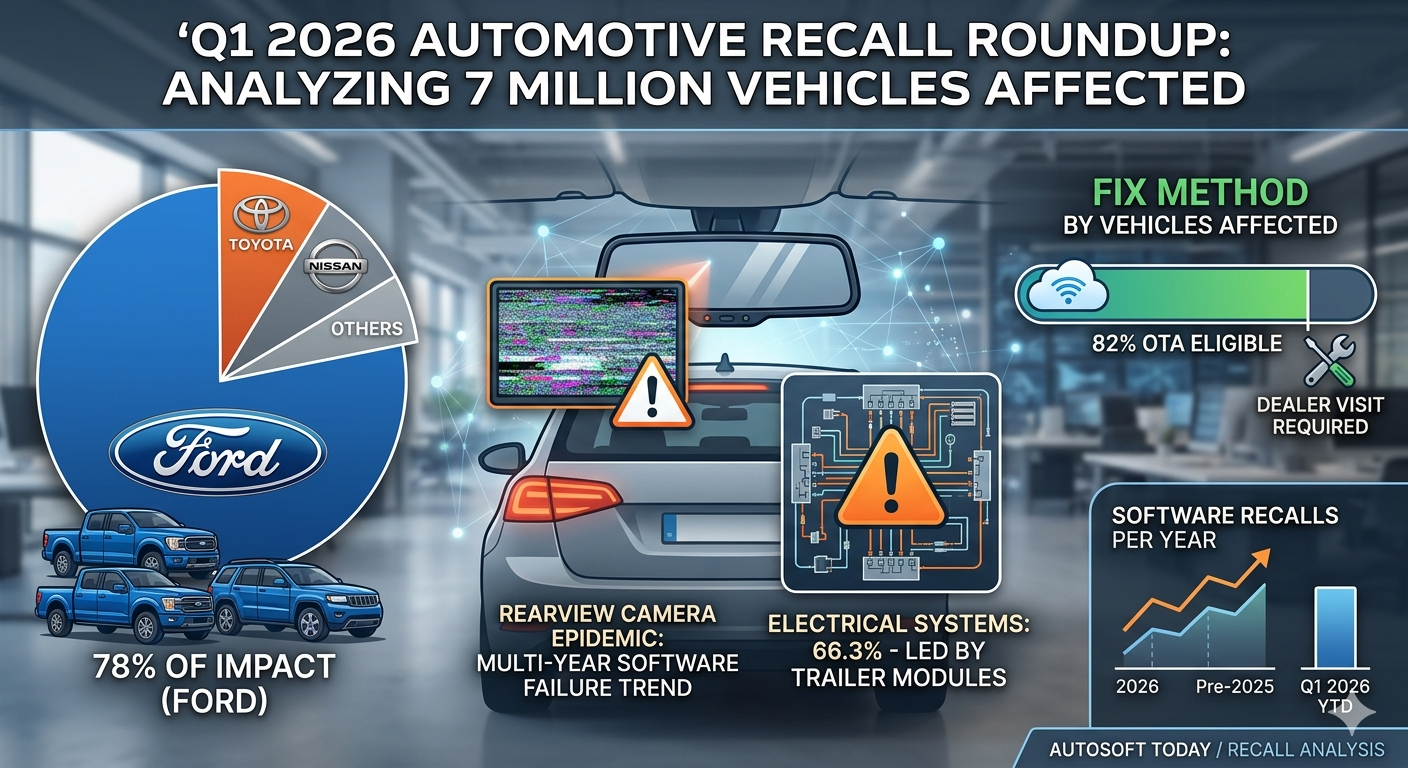
Q1 2026 opened the year with 39 software recall campaigns affecting more than 7 million vehicles — Ford Motor Company alone accounted for 78% of that impact, while the rearview camera epidemic that defined 2025 showed no sign of abating.
In this article
The first quarter of 2026 established a clear pattern: the software-defined vehicle transition continues to generate significant recall volume, with a heavy concentration in electrical systems and rearview safety technology. This is AutoSoftToday’s first quarterly recall roundup, examining the software recalls reported to NHTSA between January 1 and March 31, 2026.
Overview
Q1 2026 produced 39 software recall campaigns covering 7,050,229 vehicles — every recall in the quarter was software-related, underscoring how thoroughly software has become the dominant recall category in the modern automotive industry.
Of those 39 campaigns:
- 15 were OTA-eligible (over-the-air software update), covering 5,781,482 vehicles — meaning 82% of affected vehicles could receive their fix without a dealer visit.
- 5 were re-recalls — follow-up campaigns addressing defects that prior fixes had failed to resolve — affecting 335,975 vehicles.
- 7 were significant recalls affecting 100,000 or more vehicles each.
Annualized at the Q1 pace, 2026 is trending toward roughly 156 software recall campaigns for the full year. That would represent a meaningful decline from 2025’s record 202, though it remains above the 110–154 range that defined 2021–2023. View the full year-to-date charts and data.
Most Affected Manufacturer: Ford Motor Company
Ford Motor Company dominated Q1 2026 in a way that is difficult to overstate. Ford issued 6 software recall campaigns covering 5,529,894 vehicles — 78.4% of the entire quarter’s vehicle impact came from a single manufacturer.
The headline recall was Ford’s integrated trailer module (ITRM) campaign (26V104000), which alone covered 4,381,878 vehicles across multiple truck and SUV lines. That single campaign represented 62% of all Q1 recall vehicle exposure. Three of Ford’s six recalls were also OTA-capable, meaning many affected owners received fixes automatically.
Ford’s Q1 performance echoes a pattern established in 2025, when the company also led in both recall volume and rework frequency. Whether Q1 2026 reflects a structural quality challenge or a concentrated remediation push will become clearer as the year progresses.
Significant Recalls (≥ 100,000 Vehicles)
Seven recalls crossed the 100,000-vehicle threshold in Q1 2026. Together they account for 6,435,995 vehicles — 91.3% of the quarter’s total impact.
| NHTSA ID | Manufacturer | Subject | Vehicles | Type |
|---|---|---|---|---|
| 26V104000 | Ford | Trailer Lighting and Brakes May Not Function | 4,381,878 | OTA |
| 26V124000 | Ford | Rearview Camera Image May Not Display | 849,310 | OTA |
| 26V080000 | Nissan | Engine Failure | 323,917 | Re-Recall |
| 26V081000 | Nissan | Gears in Electronic Throttle Body May Break | 318,782 | Dealer |
| 26V165000 | Ford | Loss of Rearview Camera Image and ADAS Features | 254,640 | OTA |
| 26V038000 | Toyota | Rearview Camera Image May Not Display/FMVSS 111 | 161,268 | Dealer |
| 26V162000 | Toyota | Rearview Camera Image May Not Display/FMVSS 111 | 144,200 | Dealer |
The Nissan engine failure campaign (26V080000) is flagged as a re-recall — a follow-up to a prior remedy that did not fully resolve the underlying defect in affected Rogue vehicles. This type of multi-generation fix failure was a significant theme in 2025 and appears to be continuing into 2026.
Component Trends
Two component categories accounted for 88.5% of Q1 2026’s vehicle exposure:
ELECTRICAL SYSTEM (66.3% — 4,673,929 vehicles, 12 recalls) The ELECTRICAL SYSTEM category dominated by vehicle count, driven almost entirely by Ford’s trailer module recall. However, the breadth of 12 separate campaigns indicates this is not a single-manufacturer anomaly. Electrical system complexity in modern vehicles — particularly around trailer integration, lighting compliance, and power management — continues to generate significant recall exposure.
BACK OVER PREVENTION (22.2% — 1,562,943 vehicles, 11 recalls) Rearview camera failures were the most prolific category by recall count (11 campaigns) and second by vehicle impact. Ford had three such campaigns; Toyota had two. The rearview camera defect pattern has now spanned at least three consecutive years — 2024, 2025, and Q1 2026 — across multiple manufacturers, suggesting an industry-wide challenge with software reliability in FMVSS 111 compliance systems. This is worth watching through the remainder of 2026.
ENGINE AND ENGINE COOLING (9.1% — 643,474 vehicles, 3 recalls) Both Nissan campaigns (engine failure and throttle body) fell in this category. Together they affected 642,699 vehicles — nearly all of the ENGINE AND ENGINE COOLING exposure for the quarter.
The remaining component categories — SEATS, POWER TRAIN, EXTERIOR LIGHTING, and others — each accounted for less than 1% of quarter vehicle exposure.
Year-to-Date vs Historical Context
Comparing Q1’s software recall pace to prior full years provides useful framing, with an important caveat: we are measuring a single quarter against full-year totals.
| Year | Total Recalls | Vehicles Affected | Software Recalls | Software Vehicles |
|---|---|---|---|---|
| 2026 YTD | 240 | 13,161,879 | 43 | 7,089,716 |
| 2025 | 997 | 31,284,838 | 202 | 12,454,214 |
| 2024 | 1,073 | 35,020,506 | 186 | 14,872,204 |
| 2023 | 1,000 | 39,757,940 | 154 | 6,319,392 |
| 2022 | 1,051 | 32,270,783 | 120 | 10,301,334 |
| 2021 | 1,094 | 35,259,175 | 110 | 5,277,264 |
The 2026 YTD figures (through early April) are naturally below full-year comparisons. At Q1’s pace of 39 software campaigns, the full-year 2026 projection is approximately 156 software recalls — which would be the highest pace since 2024 (186) but below 2025’s record (202). If the Q1 vehicle-impact pace holds, 2026 could end the year with a lower vehicle total than recent years, primarily because no single recall has yet approached the multi-million-vehicle scope of some 2023–2025 campaigns — with the exception of Ford’s trailer module recall.
View the full charts and year-to-date data →
Software and OTA Recalls
All 39 Q1 2026 software recall campaigns were software-related by definition of our tracking methodology. Fifteen of the 39 (38%) were OTA-capable.
The OTA coverage rate by vehicles is notably higher: 5,781,482 of 7,050,229 affected vehicles (82%) were covered by OTA-capable recalls. This divergence — 38% of campaigns but 82% of vehicle exposure — reflects the fact that the largest recalls (Ford’s truck campaigns) were OTA-eligible, while many smaller-volume recalls required dealer visits.
Compared to 2025, where OTA recall prevalence grew substantially, Q1 2026 continues that trend. The ability to push fixes over the air remains concentrated in high-volume truck and SUV platforms where the investment in OTA infrastructure has already been made.
Five re-recalls (13% of the quarter) signal that not all software fixes are getting it right the first time — a quality dimension that warrants tracking through the rest of 2026.
Data sourced from NHTSA recall filings. Recall counts and vehicle figures reflect reports received January 1 – March 31, 2026. Year-to-date 2026 figures include data through the most recent dataset update.
Tags
- Recalls
- Quarterly Summary
- NHTSA
- Ford
- Software Recalls
- OTA Updates
- Rearview Camera
- Analysis