2025 Automotive Software Recalls: Record Volume and the Rework Crisis
2025 marked a troubling milestone in automotive software recalls: record volumes and a quality crisis where manufacturers struggled to get fixes right the first time. With 232 software recall campaigns affecting nearly 18 million vehicles — and a 13.4% rework rate — the data reveals systemic challenges in the software-defined vehicle transition.
In this article
The third in my series examining software-related recalls in the automotive industry. 2025 marked a troubling milestone: not only did the industry hit record volumes, but manufacturers struggled to get fixes right the first time. With our recently launched rework tracking feature at AutoSoftToday, we can now measure this quality crisis in detail.
The 2025 Landscape: By the Numbers
2025 represented another year of growth in software-related recalls, continuing the trend I documented in my 2023 analysis. My Envorso colleague Steve Tengler also covered the record-setting pace in his Forbes analysis from November 2025, noting that software recalls were approaching a record for the sixth consecutive year.
- Total software recalls: 232 campaigns (15% of all recalls)
- Total vehicles affected: 17,856,526 vehicles
- Average vehicles per recall: ~77,000 vehicles
- Recalls requiring rework: 31 campaigns (13.4% of total)
- Total rework attempts: 45 recalls when counting all generations
Perhaps most concerning: Ford alone issued 45 rework recalls affecting 888,691+ vehicles that had to return to dealers for additional repairs after initial fixes failed.
Top Recalls by Impact
The largest recalls in 2025 demonstrate both the scale of modern software issues and the concentration of problems in specific components:
| NHTSA ID | Manufacturer | Subject | Vehicles Affected | Rework Gen |
|---|---|---|---|---|
| 25V315000 | Ford Motor Company | Rearview Camera Image May Not Display | 1,076,138 | Gen 1 |
| 25V744000 | Toyota/Lexus | Rearview Camera Image May Not Display/FMVSS 111 | 1,024,407 | Gen 1 |
| 25V467000 | Ford Motor Company | Cracked Fuel Injector May Leak and Cause Fire | 694,271 | Gen 5 |
| 25V595000 | Toyota/Lexus | Instrument Panel Failure | 591,377 | Gen 1 |
| 25V437000 | Nissan/Infiniti | Engine Failure | 443,899 | Gen 1 |
| 25V908000 | Volvo | Rearview Camera Image May Not Display/FMVSS 111 | 413,151 | Gen 2 |
| 25V282000 | Volvo | Rearview Camera Image May Not Display/FMVSS 111 | 413,151 | Gen 1 |
| 25V657000 | Toyota | Rearview Camera Image May Not Display/FMVSS 111 | 393,838 | Gen 1 |
| 25V092000 | Tesla, Inc. | Loss of Power Steering Assist | 376,241 | Gen 1 |
| 25V900000 | Volkswagen/Audi | Rearview Camera Image May Not Display/FMVSS 111 | 356,649 | Gen 1 |
The Rearview Camera Epidemic
As I noted in my 2023 analysis, rearview cameras continue to be the most problematic software component across the industry. In 2025, this issue reached crisis levels:
- 45 recalls specifically citing rearview camera/FMVSS 111 violations
- 4.2+ million vehicles potentially affected
- Multiple manufacturers struggling with the same issues: Ford, Toyota, Volvo, VW, Honda, Lucid, Chrysler
Most manufacturers source these components from tier one suppliers. The persistent “no image” failures typically result from embedded software crashes, integration issues with the vehicle bus, or poor coordination between the camera module and the infotainment system. As software becomes a more important part of the automotive supply chain, building better validation processes and testing frameworks is critically important—work I’ve focused on with Envorso at both OEMs and suppliers.
The Rework Crisis: When Fixes Fail
Using our generation tracking system — where each follow-up fix attempt advances the generation number, as explained in the feature announcement — we can measure how many attempts manufacturers needed to fix critical safety issues. The results reveal significant quality control gaps:
Ford’s Generation 5 Failure: The Fuel Injector Saga
25V467000 - 694,271 Escape and Bronco Sport vehicles:
- Gen 1: 22V-859 (October 2022) - Initial software-only fix
- Gen 2: 24V-187 (March 2024) - Revised software approach
- Gen 3: 25V-165 (February 2025) - Third software attempt
- Gen 4: 25V-442 (June 2025) - Expanded scope
- Gen 5: 25V-467 (June 2025) - Finally added hardware replacement
This represents three years and five separate recall campaigns for a fire risk affecting nearly 700,000 vehicles. The eventual solution required both software updates and physical fuel injector replacement—suggesting the software-only approach was fundamentally flawed from the start.
Volvo’s Camera Do-Over
In May 2025, Volvo issued 25V282000 for rearview camera software affecting 413,151 vehicles. By December, they had to completely replace it with 25V908000:
- Completion rate reset from 92.56% to 0%
- All previously repaired vehicles required a second dealer visit
- Same vehicle population, completely different software remedy
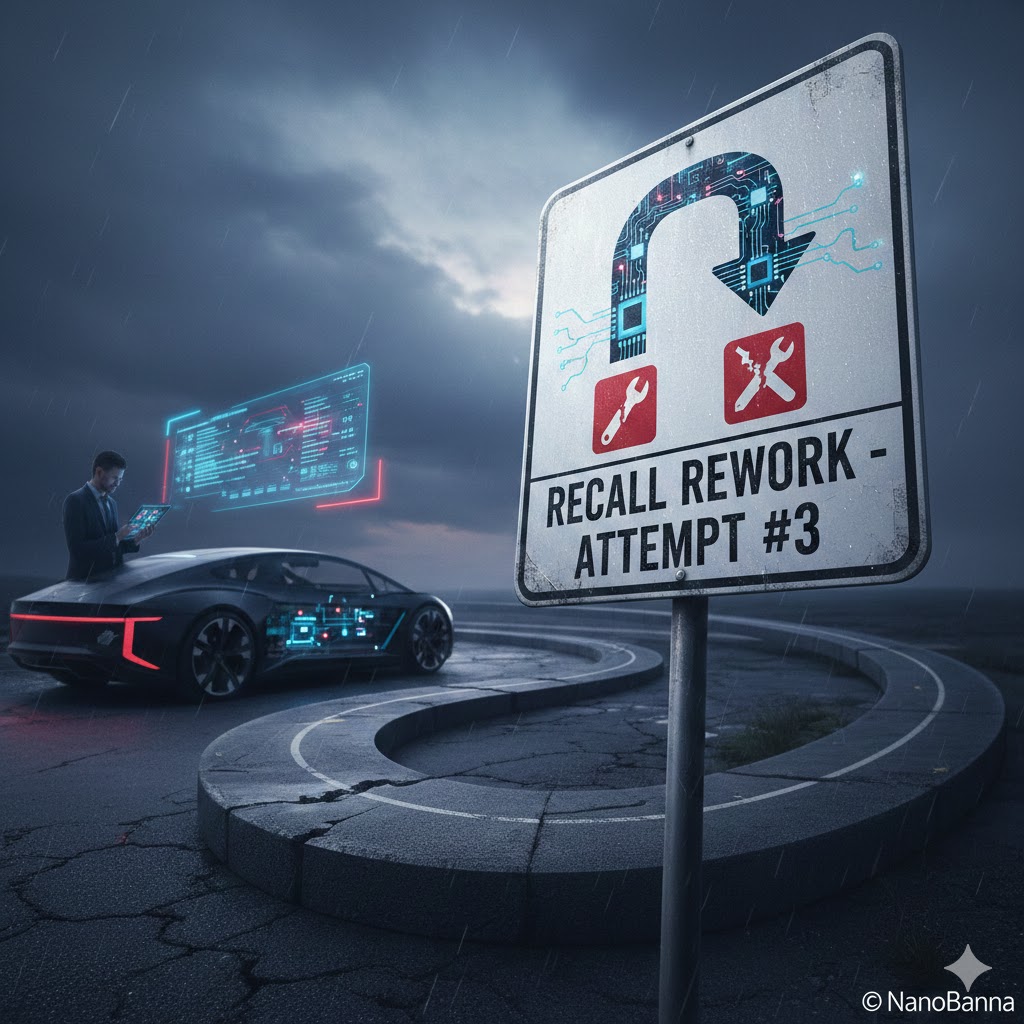
Polestar’s Triple Attempt
All 27,816 Polestar 2 vehicles experienced three generations of rearview camera fixes:
- Gen 1: 24V-477 (Initial attempt)
- Gen 2: 25V-280 (Replacement fix)
- Gen 3: 25V-615 (September 2025) - Current remedy
The official description notes: “This recall replaces previous NHTSA recalls 24V477 and 25V280. Vehicles previously repaired under those recalls will need to have the new remedy performed.”
Ford’s 45 Rework Recalls: A Quality Control Crisis
Ford’s 2025 rework rate reveals systemic validation problems. Here are the highest-impact rework campaigns:
| NHTSA ID | Models | Subject | Vehicles | Original Failed Recall(s) | Gen |
|---|---|---|---|---|---|
| 25V467000 | Escape/Bronco Sport | Fuel Injector Fire Risk | 694,271 | 22V-859, 24V-187, 25V-165, 25V-442 | 5 |
| 25V159000 | Explorer/Aviator/Corsair | Rearview Camera Failure | 49,399 | 23V-342 | 2 |
| 25V165000 | Escape/Bronco Sport | Fuel Injector Fire Risk | 33,576 | 22V-859, 24V-187 | 3 |
| 25V312000 | Bronco | Rearview Camera Malfunction | 12,219 | 22V-825 | 2 |
| 25V132000 | F-150/Maverick/Expedition | Trailer Brake Failure | 10,952 | 22V-193 | 2 |
Rework by issue category:
- Rearview camera problems: 11 rework recalls
- Instrument panel/display issues: 6 rework recalls
- Lighting system failures: 5 rework recalls
- Brake system issues: 4 rework recalls
- Loss of drive power: 4 rework recalls
The Maverick problem: Ford’s smallest pickup experienced 8 separate rework recalls in 2025, suggesting particularly troubling software quality issues in this model line.
Why Software Fixes Fail
Analysis of rework recall descriptions reveals common patterns:
Incomplete Software Fixes (42%): Software updates didn’t address the root cause, often because complex system interactions weren’t fully understood or tested. Multiple camera software updates failed validation because engineers didn’t account for timing dependencies between modules or environmental edge cases.
Failed OTA Updates (18%): Over-the-air deployments either didn’t install correctly or created new problems. Example: 25V513000 - a Mach-E OTA update to the ABS system inadvertently caused loss of power brake assist.
Hardware Also Needed (15%): The software-only approach proved insufficient, requiring subsequent campaigns to add hardware replacement. The fuel injector saga exemplifies this—three software-only attempts before acknowledging the need for part replacement.
Expanded Scope (12%): Additional problems discovered after original fix deployment, or more vehicles/systems affected than initially identified.
Validation Gaps (13%): Fixes worked in laboratory conditions but failed in real-world usage patterns. Environmental conditions, driver behaviors, or timing scenarios not adequately tested in validation.
The Cost of Rework
Beyond safety implications, rework imposes significant financial burden:
Per-vehicle costs:
- Dealer labor: $100-150 per visit (based on standard mechanic rates)
- Owner notification: $2-5 per mailing
- NHTSA administrative overhead
- Additional parts inventory and logistics
For Ford’s 888,691 rework vehicles:
- Minimum dealer costs: $88.9M - $133.3M
- Multiple mailings per vehicle: $1.8M - $4.4M per campaign
- Brand reputation damage (harder to quantify)
Owner impact:
- Repeated time lost to dealer appointments
- Erosion of trust in manufacturer fixes
- Lower completion rates on subsequent attempts
- Vehicle downtime during multi-day repairs
OTA Adoption: Promise vs. Reality
In 2025, 42 recalls (18%) offered over-the-air remediation—a modest increase from the 13% I documented in 2023. However, OTA presence doesn’t guarantee quality:
- Several OTA-capable recalls appeared in rework chains
- Some manufacturers offered OTA for certain trim levels while requiring dealer visits for others
- OTA deployments sometimes created new problems requiring dealer intervention
The OTA paradox: While OTA updates eliminate dealer visits, they don’t eliminate the need for thorough validation. In some cases, the speed and convenience of OTA may have encouraged rushed deployments without adequate testing.
Looking Ahead: Recommendations for the Industry
Based on the 2025 data and my consulting work with automotive manufacturers and suppliers, here are critical actions the industry must take:
1. Strengthen First-Time-Right Quality: The 13.4% rework rate is unacceptable for safety-critical systems. Manufacturers must invest in:
- Comprehensive integration testing across module boundaries
- Real-world environmental and usage pattern validation
- Extended beta testing programs with diverse vehicle populations
- Hardware-in-the-loop testing for all software-only fixes
2. Fix the Supply Chain Software Problem: The concentration of rearview camera issues across multiple manufacturers signals either supply chain problems or fundamental design pattern flaws. Industry needs:
- Standardized validation requirements for tier-one software components
- Better integration testing between supplied modules and OEM systems
- Shared learning across the industry about common failure modes
3. Improve OTA Validation: As OTA adoption grows, validation processes must mature:
- Graduated rollout strategies (limited deployments before full fleet)
- Enhanced telemetry to detect issues early
- Robust rollback capabilities
- Clear communication to owners about update status and any new issues
4. Leverage Telemetry for Proactive Quality: Any software defect reaching recall severity should trigger systematic review of telemetry collection. Connected vehicles provide unprecedented data—manufacturers must use it to identify issues before they cascade into recalls.
5. Account for the Full Cost of Failure: Rework doesn’t just double the direct costs—it multiplies them. When evaluating whether to release a fix, factor in:
- Owner trust erosion and brand damage
- Lower completion rates on subsequent attempts
- Regulatory scrutiny and administrative burden
- Competitive disadvantage as quality metrics become public
Conclusion
2025’s recall data demonstrates that the software-defined vehicle transition is accelerating faster than many manufacturers’ quality systems can handle. The 13.4% rework rate—and Ford’s particularly troubling 45 rework campaigns—reveals that speed cannot come at the expense of thorough validation.
As I noted in my 2023 analysis, the industry is at a pivotal point. The manufacturers who invest now in robust software quality processes, comprehensive validation frameworks, and “first-time-right” cultures will differentiate themselves in an increasingly competitive market where software quality is becoming a primary purchase consideration.
The concentration of issues in rearview cameras, the persistence of multi-generation rework chains, and the mixed results from OTA deployments all point to the same conclusion: getting automotive software right is harder than the industry anticipated. But the path forward is clear—invest in quality, validate thoroughly, and resist the pressure to deploy fixes before they’re truly ready.
Visit our rework tracking page to explore which manufacturers are improving their first-time-right metrics and which continue to struggle with multi-generation quality issues.
All data sourced from NHTSA recall database. Analysis by Todd Warren, Senior Advisor at Envorso, focusing on automotive software quality and recall prevention.
Tags
- Automotive
- Software Recalls
- Rework
- Analysis
- Ford
- Toyota
- Rearview Camera
- OTA Updates
- Vehicle Safety
- NHTSA